
Port of Preston
Preston Docks are now a marina, retail and apartment area. They are located at the western edge of Preston and the lock gates open to allow in the river at high tide.
Related pages:
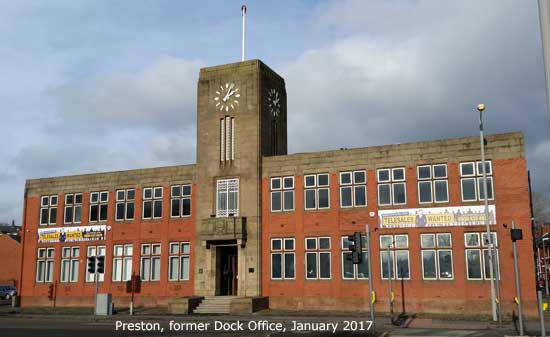
The former Dock Office
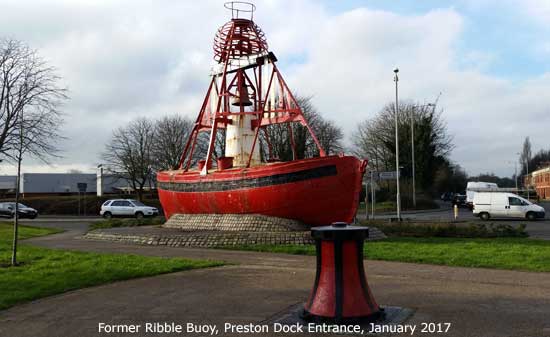
The Entrance to Preston Dock
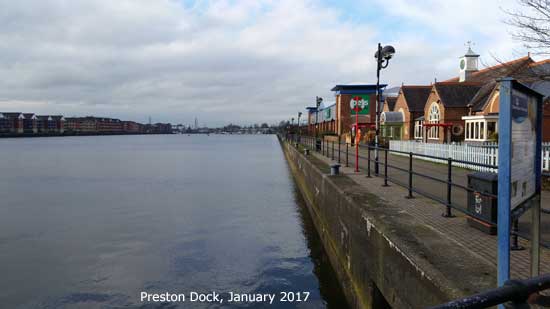
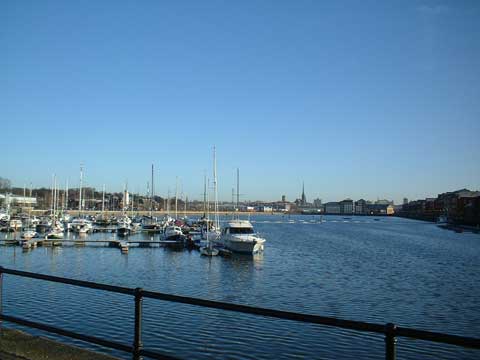
The main dock:
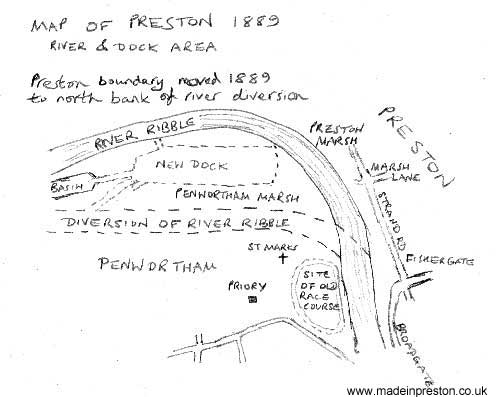
The new dock at Preston was opened in 1892. There had been discussion from the beginning of the century about expanding the quays that lay along the River Ribble. The work would include diverting the river away from Strand Road and digging a main dock and an outer basin.
Also the river is tidal only for a few miles beyond Preston so it would fluctuate greatly in depth and require constant dredging. Tides at Lytham vary from 20 to 30 feet and Preston is some 9 miles upstream so at high tide there is deep water and dredging can enable fairly large ships to reach Preston. People spoke of the ships that appear to be crossing fields as they pass Freckleton Marsh.
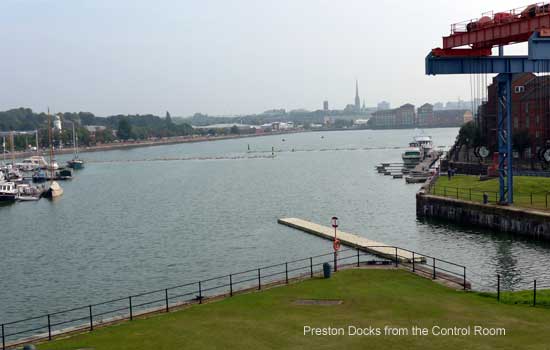
The main dock was called the Albert Edward Dock after Queen Victoria's husband. It was one of the largest single docks in the country, and still is. When visiting such places as Albert Dock in Liverpool it makes Preston look massive as a single dock.
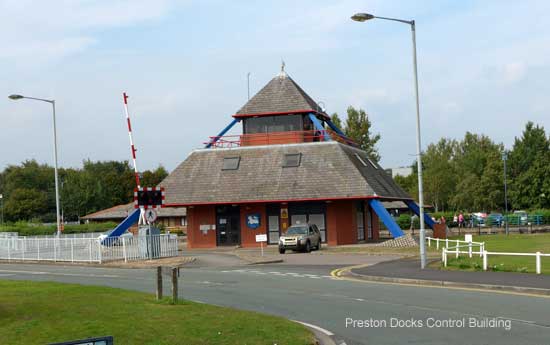
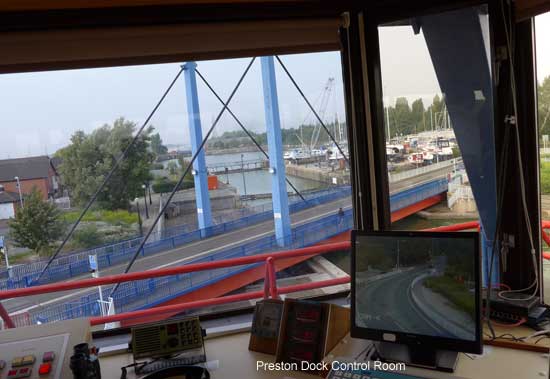
Image showing the course of the River Ribble before the dock was built, note the first river bridge was the narrow bridge, now closed to traffic, at the end of Broadgate.
When the electricity power station was built on the other side of the river a coal conveyor belt was built from the dock over the river to the power station. Also a pipe was laid under the river to enable the dock to be used as a cooling source. Every now and then steam would rise from the dock water at the south east corner. The power station was knocked down.
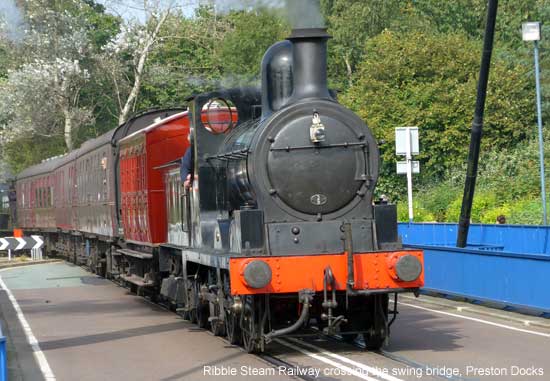
Other features were the railway line that went under the town from the main station to the dock and then by level crossing over Strand Road. This line is still there and is re-opened for tar trains to the tar works. A railway museum, Ribble Steam, has been built on the dock and leisure trains are run from the dock.
The port had it's own sand-pump ships that stayed in the estuary most of the time. My father used to get the bus from Preston to Lytham carrying the wages in cash for the sand-pump crews. He'd then get a boat from Lytham up to the ships and pass over the pay-packets. Probably need a security firm to do that now. He usually got us some shrimps from Lytham on that day.
The Dock Office seemed an old fashioned place with varnished wooden high desks and panelled walls in some rooms, although panelling was common for VIP rooms in large organisations at that time. It still stands and is a smart art-deco looking building with a small clock tower outside the main gate. I don't know if its listed but in my opinion it should be.
Anthony Donlan advises;
'My father (Joe Donlan) was a founder-director of Ferry Trailers Ltd., the firm who pioneered, with the help of a gentleman called Colonel Bustard, the roll-on-roll-off service between Preston/Larne and Preston/ Belfast. They used tractor units in both Preston and Northern Ireland to tow loaded trailers on to the vessels (Empire Nordic, Empire Celtic, Bardic Ferry and Ionic Ferry.) Some of these vessels had been 'tank landing crafts' during the Second World War and they were requisitioned during the Suez Crisis of 1956, although I don't think they were actually used. Ferry Trailers Ltd. was sold to British Road Services in the early 1960s.'More about roll-on-roll-off further down.
The dock was always a financial problem for the town as it never made money in its own right although as a greater entity it brought jobs and outside money into the area. In particular the many public houses near the port.
The port competed with Liverpool for trade mainly to Ireland. Nearby there were also Lancaster and Fleetwood ports at various times. There was also fruit from the West Indies and woodpulp and timber from Scandinavia and Russia. A small Fina oil depot was at the port and oil was imported.
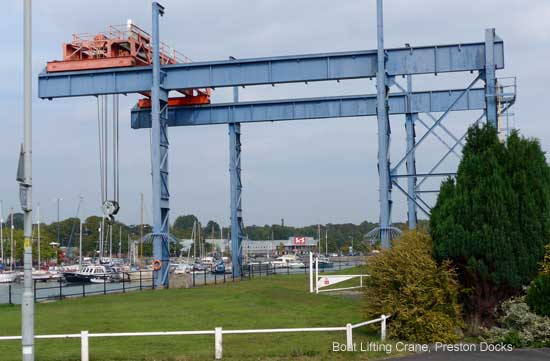
In later years Preston experimented with Roll-on and Roll-off traffic and was a pioneer in that field. However it brought in other difficulties such as labour disputes about how much manning was needed. A large crane was bought for container traffic and was never efficiently utilised. Before that time dockers had been treated as casual workers and had recently earned the right to guaranteed work, coupled with the general explosion in worker power, managements inability to deal with this new phenomenon, high levels of inflation and a lack of industrial stability became a national feature in the 1970's. The building of the motorways enabled traffic from Scandinavia and Europe to dock on the east coast and lorries to quickly reach the west, also there was a move to larger ships and problems with maintaining the river depth. The Port of Preston was unable to survive these events and the council pulled the plug in the early 1980's.
After its closure many grand plans were laid including a proposal to fill the dock. A long term development plan evolved and today the dock is surrounded by modern apartments, supermarkets, multiplex cinemas, a large gymnasium, drive in fast food outlets,offices and contains a marina. Its large expanse of water and high quays doesn't exactly make it appear cosy. Over to the east the Pennines can be seen, to the west the flatness of the Fylde creates a big sky. A dual carriageway enables easy access west towards Lytham and Blackpool and a southerly by-pass enables faster access south to the M6, M61 and M65 without travelling through Preston.
Some personal ramblings, I used to walk round the dock area regularly in the late 1960's usually eating a pie at lunch-time. I had friends who got part time work unloading bananas during the summer holidays. Many a tale of very large spiders hiding in the bunches of banana's. My father worked in the dock office all his working life, except for the war, over 40 years. Several young men in the Dock Office volunteered before conscription and were killed when their ship sank enroute to Singapore, I recall my father saying although I have never verified it. He cycled to work all those years.
The public car park outside Homebase is useful for a walk around the dock and a crepe from the Green Frog food stall isn't so bad, you can also walk along the river into town from Penwortham Bridge, see link to Walk in Preston.
You can also park in the Park and Ride at Portway and get the bus in, yet it's not far and you could walk, although the council will be upset if you do.
See also the websites: Preston Docklands and Marina Riversway
The port is also the base of the Ribble Steam Railway. This is a standard gauge track of about 1 1/2 miles that west of the dock and over the swing bridge between the main dock and the basin. The railway runs passenger trains mainly at weekends. There is also a workshop / museum where viewing of the loco's is possible.
More recently the dock area and along Riversway has become the main car dealer area of Preston.
Every year a carnival is held called the Preston Riversway Festival. See our page.
Read more:
The Last Tide, A history of the Port of Preston 1806 - 1981 by Jack Dakres.
Some very interesting information in this book. Plenty of original research done so I'm not going to be lazy and copy his work. An interesting section about how the ships had to time their entry and exit between the bar off Lytham and the basin to make the best of the tidal flow and depth.