Lancashire Councils’ Re-organisation

The government wants Lancashire to re-organise into larger 500,000 people council areas.

True to form most areas of Lancashire have different preferences.  This results in 5 options for the 1.6m population.  Any option above 3 councils doesn’t meet the governments target of each council covering 500,000 people.

South Ribble has more association with Preston than other areas having largely once been part of Rural Preston but this isn’t the preference of either area.

Preston prefers to join with Lancaster and Ribble Valley which overall would create 4 new councils averaging 400,000 people each.

The only compliant proposals are:

Two councils: populations around 800,000 each.

The 2 would be divided into north and south by the River Ribble.

Three councils: populations averaging 533,000.

1. Chorley, Preston, South Ribble and West Lancashire.
2. Blackpool, Fylde, Lancaster and Wyre.
3. Blackburn with Darwen, Burnley, Hyndburn, Pendle, Ribble Valley and Rossendale.

This is supported by 5 of the 14 councils.  The 4 council solution is preferred by 6 councils plus one council that prefers a different four.

Our preference is for a one Mayor of Lancashire solution over 4 councils.

Greater Manchester has 10 authorities for 2.8million which is 280,000 each.  With the Mayor sitting above.   Could Lancashire have one Mayor sitting over the 4 or a 5 council option solution?  Where would the Mayor sit:  County Hall, Preston.

The report on the BBC website has useful maps and tables, click here.


Two more murals spotted 28th June 2024

Two more murals in Preston.  Both viewable for the delight of train travellers.   Although one isn’t new.

This first one appears new and can be seen from a train inbound from Blackpool.  Four o’clock low when you see the docks.  Blanche Street, behind the Wheatsheaf pub, Water Lane.

This is almost on a par with the mural ‘Mother’ for skill and meaning and painted by the same artist, Shawn Sharpe.

As a first thought binding Preston’s cotton mill heritage to the workers at the mill and the hand that picked the cotton.

As another thought, a feminist feel perhaps.  The dungaree wearing lady has a 1940s land girl style, representing the part women played in the mills and fields since industrialisation began.  The mill is Tulketh Mill with it’s iconic chimney and tower, now a call centre.  The lady could be Sally, pride of our Alley, hard working, tired and strong.   PP, or Proud Preston, with a pink background, traditionally female pink?

The great thing about this are the multiple themes and interpretations.  You could write a book.

The link to cotton - a mural in Blanche Street Preston
The link to cotton – a mural in Blanche Street Preston


The second mural has been there quite a while and faces the Railway Station Butler Street entrance on the side of the Station pub.  It’s well painted with an urban feel.  This one has been done before the recent trend for meaningful and locally themed murals.

On close inspection it’s very well painted with a lot of detail such as the marking on the cheeks and in the blue rim. Melting on the left and underneath.   To try to interpret it brings us to fanciful words about the melting of society and global warming when perhaps it’s just an urban feeling.  A night out.

This is the ramblings of an aged gent, open to thoughts.

A mural in Butler Street in Preston, facing the railway station.

Tail winds at BAE Systems Lancashire

First there was Tornado, then there was Typhoon and what next?   The concept for the anticipated next aircraft project at BAE Systems in Lancashire and the Royal Air Force has been announced as the Tempest, photographed below.

Tempest Concept Aircraft

A concept design for a two engine fighter bomber with a capability to fly unmanned.  The UK government has allocated £200m a year for 10 years and there is a partnership with BAE Systems, Rolls Royce engines, MBDA missiles and Leonardo of Italy plus of course UK MOD and RAF.

As usual the partnerships for the next European Combat Aircraft are being debated with rival offerings from the big players.   Earlier this year Airbus and Dassault of France announced they would partner for the next Future Combat Aircraft project excluding the UK.   The UK continued with its discussions with Japan, Sweden and Turkey.   More recently, in fact this week, the head of Airbus proposed that BAE Systems merge its military aircraft business with Airbus and there is talk from France and Germany for the UK to join their project to strengthen European Security.  Slightly ironic considering the UK is being excluded from the European GPS system due to security.  The difference between politicians and industry perhaps.

The RAF is looking to be flying the Tempest by 2035 along with the Typhoon and Lightning II (F35).   As future partners are unknown it can’t be said what the future workload will be locally.  A partnership including France is likely to result in a debate about who leads and who gets which juicier parts of work.  Other partners are likely to allow the UK to lead the project which usually means designing and building the forward end and cockpit.  In any event it’s likely that Final Assembly which involves test flying will be in the UK, hopefully at Warton, for RAF aircraft.

At the Farnborough Air Show the UK also announced that Typhoon will be used as the  bridge for technology on the Future Combat Aircraft.   Several upgrades will be introduced later this year and future technology used to keep the Typhoon in service for another 30 years.

Work in Lancashire continues on Typhoon manufacture and development, F35 rear fuselage work is ramping up.  Other concept projects like Taranis and now Tempest will hopefully lead to another 30 years of work taking the local sites to over 100 years old.

Preston pipped by Lancaster for the highest EU Remain Vote in Lancashire

In the EU Referendum all 14 Lancashire areas voted to leave.   By percentage votes it went Preston 53/47 for leave,  Lancaster 51/49 for leave.  Highest leave was Blackpool 67/33 with Burnley next 66/34.

Preston and Lancaster have large student populations which are said to swing the vote towards Remain.  Whereas areas with big retired populations or higher unemployment are said to vote to Leave.

Nigel Evans MP for Ribble Valley was probably the most prominent MP of this area on television at the results, and was overjoyed.

Some £200 million is said by the Lancashire Evening Post to be allocated by the EU to Lancashire in the next few years.  Many would say it is money we’ve already paid to the EU.   However it was said in the campaign that all UK funding to the EU including an extra sum to cover the unpaid rebate will be allocated to the NHS,  so this Lancashire funding perhaps won’t go beyond the leaving date currently potentially September 2018.

Christmas Holiday Rain Brings Floods on the Ribble

The River Ribble broke its banks twice over the holidays reaching its highest ever level at Walton Le Dale.

The Environment Agency records that 40 significant events have been recorded since 1600. The most significant was in 1866 when flooding occurred on the Ribble, Calder and the Darwen, when newspapers recorded widespread flooding of businesses and properties. More recently in 1995, 38 properties were flooded in Preston, Walton le Dale and Ribchester and a similar event in 2000 also flooded Padiham, Barrowford and Blackburn affecting 33 properties. In 2002 the Calder and Darwen flooded affecting 18 residential and 40 commercial properties around Blackburn and Burnley.

The Environment Agency report in 2009 said 2,300 properties are at high risk of flooding in Preston and Walton Le Dale.  This will grow to over 5000 due to climate change.

The sources of flood risk vary, from the risk of direct flooding from the River Ribble in areas of Preston and Walton-le-Dale, to the flood risk associated with culverts in Preston such as Moor Brook, Swill Brook, and Eaves Brook. In addition, the influence of the tidal Ribble estuary, into which many of the rivers in this area drain, can lead to rivers ‘backing up’ during high tide conditions, which can increase flood risk as flows start to build up at tidal outlets.

Large amounts have been spent on Watery Lane near the docks improving drainage.  These projects are big, expensive and disruptive.  The Ribble reached its previous record in 2012 and you might wonder if dredging the Ribble will be an option long after the last Port of Preston dredgers and sand pumps were disposed of.

Devolution of Lancashire

The councils of Lancashire are considering the benefits of combining under a single authority to obtain new powers devolved from central government.  This has been done in Greater Manchester who have agreed to have an elected Mayor.  Other cities and areas are looking at taking it on board.

The 15 councils are Lancashire, Preston, Blackburn with Darwen,  Burnley, Pendle, Hyndburn, Rossendale, Lancaster, Blackpool, West Lancashire, South Ribble, Chorley, Ribble Valley, Wyre and Fylde.  They will each vote on whether to take it forward.  So far 5 councils have agreed and one rejected.

Wyre has voted against as they say no benefits have been identified.  They also claim the government is insistent on an elected Mayor but other councils are ignoring this believing it can be achieved using ‘co-opted members and chairman’.

It should be noted that Greater Manchester has used the co-opted committee system for a long time and have been told a Mayor is essential.

The co-opted system seems reasonable but the idea of the Mayor is to have elected power whereas the co-opted Chairman will not have any legitimacy electorally.   A bit like the appointed European Commission.


Lancashire County Council budget cuts

Lancashire County Council put a number of proposals forward to reduce their expenditure to meet the allocated budget from the government.

Some headlines are the closure of the Museum of Lancashire on Stanley Street, plus several other museums including Helmshore and Queens Street Mill in Burnley which are interesting presentations of Lancashire’s cotton industry.   Helmshore having a display of Richard Arkwright, born in Preston and inventor of the water frame.

Over half of the Lancashire Libraries are slated to be closed. Some unofficial comment being that areas with 2 libraries will have one closed.  Also rural bus services are to be cut back including the Fleetwood to Wyre Ferry which has been on regional TV.

In some cases it appears the proposal has been made in the hope that it will encourage other funding sources to come forward.  Perhaps the Fleetwood ferry is one and all over the country libraries are being kept open by volunteer staff.

Some comment on the news from an East Lancashire MP was that Lancashire has taken on board Preston bus station and is a waste of money.

Whether thse proposals are approved will be discussed in council this week.

Denis Healey RIP and his Preston Effect

Denis Healey, a forceful Londoner brought up as a Yorkshireman, died this weekend at the grand age of 98.  After impressive war service, gaining an MBE in 1945, he joined the Labour Party becoming an MP in 1952.  He was a minister through a turbulent time in British politics between 1964 and 1979 and in the shadow cabinet up to 1987, retiring in 1992.  As new Defence Secretary in 1964 he made decisions that had a major effect in Preston.

The TSR2 was a big project to build Britain’s next bomber. Stuffed with the latest high technology it was a large aircraft to be able to fly at supersonic speed beneath the Iron Curtain at night.  The British aerospace industry had been restructured around the aircraft with Preston’s English Electric Aviation plants transferring to the newly formed British Aircraft Corporation.

On election in 1964 the new government significantly cut defence expenditure and with it the TSR2, which was to be replaced by the American F111, an order that was also later cancelled at some cost.

At the time this resulted in thousands of redundancies, but it also spawned the beneficial era of international collaboration in defence projects. At the Preston area sites this includes; the Anglo French Jaguar, the Anglo-German-Italian Tornado and 4 nation Eurofighter Typhoon which have brought expansion, good jobs and continuity of work to the area despite ups and downs.

Sometimes major disruption can be for the better in the longer term although the cycle continues.

Just a footnote perhaps in the career of Denis Healey. RIP.

TSR2 at RAF Museum Cosford

Preston City Region

Preston is home to Lancashire County Council and perhaps that is why Preston has never rocked the boat and become a Unitary Council such as Blackburn & Darwen and Blackpool.  Talk of devolution to the north of England opens the doors to many options and perhaps is one reason why it’s unlikely to happen.

Lancashire already has the Lancashire Enterprise Partnership and a City Deal to focus investment covering Preston and it’s surrounding area.   Recently Manchester has been given bigger powers and control of budgets in return for having an elected Mayor.  Could this be done for Preston and in effect would this be more like splitting Lancashire into west, east and perhaps north.  With Preston being the centre of the western part.

The metropolitan boroughs such as Wigan and Bolton are effectively single tier government.  With Wigan having 75 councillors by combining what was formerly 14 separate councils.   Greater Manchester is managed by a Combined Authority of a representative councillor from each borough.

Whether dividing Lancashire into Preston, Lancaster and Burnley regions would provide advantage isn’t clear.  It would reduce elections if Lancashire was run like Greater Manchester.  There are personal attachments to the name Lancashire so sentiment might play a part as much as logic.

The rural areas of such a region would be Conservative while Preston itself would be Labour.  Who would hold the balance? This creates another difficulty as the strongly Conservative rural areas would not want to effectively give up their autonomy if it could be outvoted in a bigger council and vice versa.  Wigan and its merged constituents is almost entirely Labour so there is no political obstacle.

It could also be said that local accountability is better based upon Lancashire and the smaller local councils that we have now.

Management Redundancies at BAE and Lancashire County Council

In the last few weeks BAE SYSTEMS announced between 150 and 450 management job losses at their Warton plant.  Lancashire County Council announced 150 management job losses.

BAE said they hope to re-deploy some people to other parts of the business and both organisations will be looking for volunteers.

Both organisations have reduced headcount in the last few years.  It’s often difficult to establish how many people have left an organisation as out-sourcing may reduce the numbers directly employed.  Sometimes the jobs remain but the staff change employer .  Also many organisations have natural wastage and people under threat are allowed to take other roles.

It can be a traumatic time,  although a redundancy package at the right stage of life can be a very good thing for some.  Some job shuffling to allow this to happen is the decent way to go about it.

The United Kingdom and Northern Parliament

The UK / Great Britain are famous brands respected all over the world for democracy, legal system, science, culture, innovation and more.   It seems amazing that people suggest they are willing to give it up and split the country into smaller parts.

The Lancashire Evening Post today contains an article about a debate in the Continental Hotel in Preston on the effect of Scottish independence on the north and if the north should have it’s own parliament.

It’s hard to see what benefits either of these things can have.   Influence is largely based on size.  It’s no surprise that Germany is powerful in the EU, as well as their industriousness they’re by far the biggest country in terms of population.  Splitting the UK can only damage it’s influence and prestige.  To some influence and prestige may mean little but if you’re looking to get a contract and can offer a big reciprocal market it can swing the deal. Similar with world status in the G7, IMF and UN, a voice there can win friends where you are looking for benefits and deals.

A northern parliament will benefit the local politicians who will have more power.  It would add another layer of government and potential for arguments with central government. Perhaps it would be more left leaning and some would think that good if it gives some freedom from a right leaning central government.  Although it might not have enough powers to make significant changes in those areas.  It could be that if taxes in the north were higher than the Midlands then moving a few miles into a lower taxed area would be something you wouldn’t worry about and it could accelerate the movement of jobs south.  Or maybe if benefits were better in the north the unemployed would move north.  Whereas a Scot might think twice about moving into England.

With independence Scotland will be free they say!  The freedom will be to have limited scope  for change at home, not even having their own currency, and to be of no consequence whatsoever on the world stage.   In many ways Scottish independence could benefit the north as many jobs in shipbuilding, government and defence are based there and they’d possibly be moved to the north of England. Those northern windmills could be more affordable rather than subsidising Scottish windmills.  Although overall it would damage the UK in terms of size and influence.  There’s no doubt to me all sides are better together.

Transport Investment around Preston

On top of the Northern Hub which will deliver electrified rail for the rail links from Preston to Manchester via Bolton and via Wigan and to Blackpool we have fresh discussion on a ‘northern powerhouse’.

The Northern Powerhouse is the name given to a scheme that is intended to help revitalise the north of England and to rebalance the level of investment between the north and south.   It will link 5 major cities of the north with ‘high speed’ rail, meaning over 125mph not the full standard over 200mph track but still possibly designated ‘HS3’.  This will be on top of the high speed rail system HS2.

Unfortunately neither HS2 or ‘HS3’ reach Preston.  Although Preston will get benefits from HS2 such as 30 minutes off the current London timing of just over 2hrs.

Also locally there is the Preston and Lancashire City Deal which will add some £400m to the local economy for rail, road and housing.  This will provide local improvements to complement the bigger national improvements. The test is whether Preston can or should become a part of the Northern Powerhouse and what it offers for Preston and Preston offers it.

Towns like Blackburn and Blackpool will also want to know how they can benefit rather than being satellite towns.  Preston has the benefit of being on the M6 and the West Coast Main Line although further south the town of Wigan is closer to the edge of the planned systems investment.  Preston has a skills benefit being an existing major administration  and education centre and having a long term advanced technology industry in aerospace and vehicles.

It does appear that all major regional investments lead to Manchester.  This has some benefits to Preston but we need to get extensions to these routes to take in the hub of Lancashire, which is Preston.

Preston Draft Master Plan – 5,000 new homes


Preston Draft Master Plan - 5,000 new homes
Preston Draft Master Plan – 5,000 new homes

The Preston Draft Master Plan will be published for consultation on 20th January 2014.

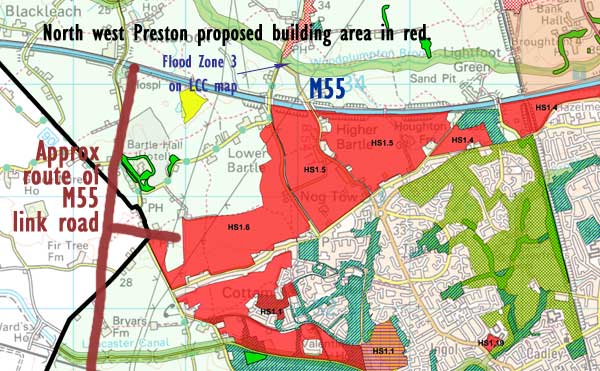
It is said to contain plans for 5,000 homes in north west Preston along the south side of the M55 motorway.  These will be in the form of a ‘garden city’ which might be influenced by new regulations being promoted.

The new Regulations are expected to require that developments must have ponds and streams to absorb heavy rain so it isn’t all dumped immediately into the drains causing them to overflow and flood.  It’s proposed that maintenance of the ponds and streams will be paid by an annual levy on the residents in the new developments.

This area is good countryside blighted by the M55 which provides the excuse for not feeling too strongly about it.  Although it’s well away from employment areas so will be in need of roads with commuters expected to pile onto the M55 or into Preston Centre.  From that point of view 5,000 houses, perhaps 13,000 people, sounds excessive.

It’s downwind of the nuclear processing plant as well.

Whether the next step might be to build north of the M55 will cause concern about impacting the pleasingly rural feel of Woodplumpton.  Also surely it isn’t a plan to reduce the solid Conservative majority for that parliamentary seat by changing its character.

Preston Council and Central Lancashire City websites contain the documentation leading up to the decisions and probably will contain the draft Master Plan later this month.  There is a lot of reading there, could do with a simple summary.

Lancashire City Deal let’s see the action

An impressive Business Insight supplement in The Times newspaper, Tuesday 10th December, covering Preston, South Ribble and Lancashire’s big City Deal and Leyland Trucks.

The articles give a very rosy, unquestioning picture but it is said infrastructure and education are key investments to enable prosperity, and that is what is happening.

This City Deal is worth £434m and has a target over 10 years to generate 20,000 new jobs, £1bn in gross added value, 17,420 new homes, £2.3bn in leveraged commercial value, some school and health facilities.  On the face of it this is growth although it isn’t clear if it makes up for any shrinkage anywhere.

It’s complemented by Enterprise Zones, Superfast Lancashire broadband project, Boost Business Lancashire and a host of local initiatives.

£334m will be for infrastructure and include four major road schemes such as the Warton link to the M55 and 4,000 homes, Broughton By-pass and 1,400 homes, Penwortham By-pass, South Ribble distributor road and 2,700 homes.  An additional £100m from the Lancashire Pension Fund will be invested in housing and development.

The article says Leyland Trucks are seeking to position Leyland at the forefront of building up a major automotive supply chain in Lancashire.  In this it is supported by the MD, Ron Augustyn, being a member of the government’s Automotive Council.  No doubt many of the parts are imported so adding to the local supply chain should bring benefits to the plant, let’s hope it succeeds in that.  Some 40% of output from the assembly plant at  Leyland Trucks is exported.

The article also covers Boost Business Lancashire which is £7.2m from the European Regional Development Fund with the aim to grow the local economy by £20m and create 1,200 new jobs.  235 businesses have signed up to it this year.

City Deals put the onus onto the locality to give its best shot, it could be said that in this it beats the scrapped Regional Development Agencies in being more local.  The City Deal covers the roads, houses and some schooling and health.  The electrification of most of the railway in the region has already been announced.  Let’s start to see some action.

Grade II Listing 1416042: Preston Bus Station

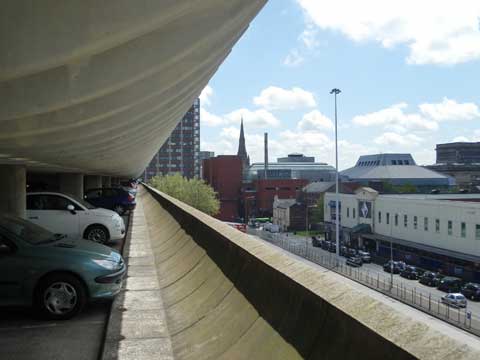
Preston Bus Station, Grade II listed.

The campaign to save Preston Bus Station was given a boost this week when the bus station was listed by English Heritage.  This puts the bus station in the top 800 post war heritage buildings in England.

The listing of the building makes it eligible for grants from the Heritage Lottery Fund and others. However these are usually only obtained after a protracted application process.

Some big figures for refurbishment have been offered, up to £23m.  Are these realistic?  They’re unlikely to be reduced by listing as there will be a need to preserve listed features. A strategy of prioritising and phasing the work may enable grants to be obtained in easier to achieve smaller applications.

Preston Council are having difficulty balancing their books and are looking for a quick kill.  It should not therefore be considered that this is the end of the story.  We eagerly await their next step and hope it is a positive one.  The potential pots of money totted up along with a pragmatic plan of refurbishment, improvement and integration into the city plan will be more good news.

Lancashire County Council offered support to build a new bus station but not to maintain the old one.  It could be argued their interest has therefore been declared, they obviously have a few million pounds in their budget for Preston Bus Station. Despite Councillor Rankin saying it is an issue for Prestonians, the bus station is a regional hub.

Blackpool have a large £28m development underway in the centre of town for new council offices and refurbished ex-bus station and car park.  Where do they get their funds?

It is said councils can borrow cheaper than private companies.  Let’s be positive, the economy is on the turn, interest rates are very low, is it time to borrow for the bus station.


What does listing mean? 

There are 4 categories of English Heritage listing; I, II* (two star), II, III.  On 23rd September 2013, Grade II (two) listing was announced.   This means the building is nationally important and of special interest.  Less than 0.2% of listed buildings were built after 1945, this makes it 1 of around 800 post war listed buildings in England.

Listing means that consent must be applied for to make any changes which might affect its special interest.  However it can be altered, extended and occasionally permission is granted to demolish a listed building.

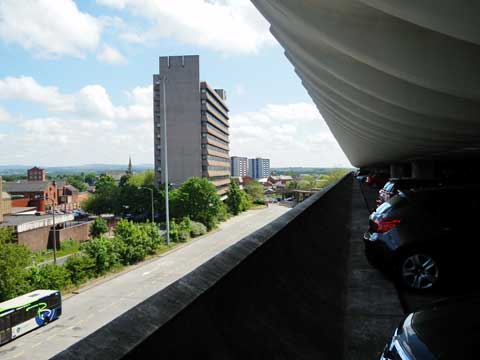
Preston Bus Station is listed entry number 1416042.   Its features of note are its curved concrete front on the car park decks that focus on the great length of the building. The original fittings, floors and signage survive and make an important contribution.  It is an example of 1960s integrated traffic planning.  The listing includes the car park ramps and taxi stand but excludes the 3 passenger subways.

Reference:
http://www.english-heritage.org.uk/

Local interest in ‘The White Queen’ on BBC

The BBC historical dramatisation ‘The White Queen’ based on a book written by Philippa Gregory, seeks to give a female perspective to history in the 15th Century by portraying events from the Queen’s view.  The three ladies most in the drama are Elizabeth Woodville, Anne Neville and Margaret Beaufort.  You may say you’ve never heard of them and that is what the programme seeks to address.

Following defeat of the House of Lancaster by the House of York, Elizabeth Woodville, a Lancastrian marries the new king and becomes a Yorkist.  Margaret Beaufort is mother to Henry Tudor the future Henry VII and lives at Pembroke Castle in Wales. They say the code of chivalry enabled women to survive when their husbands had been brutally murdered after being on the losing side in battle.

Basically Lancaster is all but finished but Henry Tudor is their hope.  Margaret Beaufort is a woman of very strong belief with a mission to put her son on the throne.  After the death of her husband in battle with the Yorkists she marries Lord Stanley.  This is the local link.

Lord Stanley is a major landowner and ruler in north-west England. He’s known to have a foot in both camps and manages to remain alive who-ever is in power.   Stanleys were in their seat at West Derby, now in Liverpool, and known as the Earl of Derby (in Lancashire). Although Liverpool wasn’t significant in the 15th century.

The Stanley’s were MP of Preston. Several parks, pubs, even a football team in the region are named after them.  Greenhalgh Castle at Garstang was built by the same Stanley as in the White Queen in 1490, it was ruined by Cromwell in the Civil Wars.

Another regional link is that a painting of Elizabeth Woodville hangs in Dunham Massey (National Trust) near Manchester.  Don’t know why though.  Click Here for a link to a print of it.

This is an interesting programme although difficult to grasp who the main players really are until you’ve watched a few episodes.  The companion programme, The White Queen and her rivals, also on now assists in making sense of it.

Preston Bus Station conspiracy theory

The Evening Post published a story yesterday that the recommendation of the consultants was to refurbish the bus station.  To add a touch of mystery it is alleged this part was deleted at the request of Lancashire County Council (LCC) before it was shown to Preston Council.

In their defence LCC said the cost of £23m was way outside budget and that the option was also outside of the scope requested.

It has been suggested by others that a refurbishment could be done for much less.  In the absence of any artists impressions or plans for the proposed new bus station it seems Preston Council and the public are being asked to support what could be a pig in a poke.

Read the full story in the Lancashire Evening Post.

http://www.lep.co.uk/news/business/preston-bus-station-report-was-altered-1-5777002

Is Stoke giving Preston a Bus Station message

Preston’s Council Leader gave us his version of the Bus Station Blues on the BBC Culture Show last week.  It seems it will be knocked down on the altar of day to day council services and pressure from Lancashire County Council.

If you want to get depressed take a walk from the unloved Bus Station into the Guild Hall Arcade and the Victorian Covered Market.  These buildings all look like time is not on their side.

Also there are a lot of cars on the Bus Station.  Will the Park and Ride on Bluebell Way take the strain.  It’s a long way out, what is the plan.

You might wonder how accountable Lancashire County Council (LCC) is when they can happily offer a new bus station and let Preston’s Council take the blame for knocking down the old one.  Although Preston’s leader said no-one from outside Preston should have a say,  it seems LCC is having a big say.

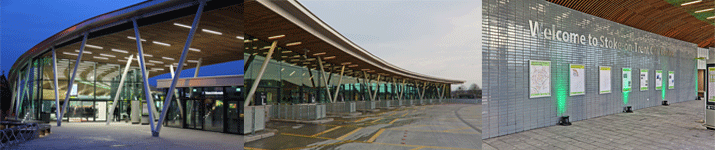
Stoke's £15m Bus Station opens 1st April 2013
Stoke’s £15m Bus Station opens 1st April 2013

Could LCC offer anything like Stoke’s £15m new Bus Station with 22 bays, half of Preston’s need. Built on a car park so no demolition cost involved.  Yet the cost of Preston’s new bus station, which will be twice as big and include demolition won’t be much different.

Is there a message here that Preston is going to get a second rate bus station, a bus shelter perhaps with an Eaga Bites van parked at the entrance.  What does this say about Preston?

The Preston Doomsday Scenario

It’s easy to sit at home and scoff about Doomsday Scenario statements from the leader of Preston’s council as reported in the Evening Post.  Today’s comment about the Guild Hall being on the agenda for cuts or even knocked down sounded dramatic and it can’t be certain if it was posturing against central government or positioning for the bus station debate.

The suggestion of bringing in an entertainment company to run the Guild Hall is similar to Blackpool where the council brought in Merlin Entertainments, operators of Madam Tussauds, to run the Tower.  Sounds reasonable, if possible.

Given that the Guild Hall is Preston’s only large entertainment centre it’s unlikely to be knocked down.  Although the Guild Hall isn’t a place I’d suggest anyone goes to have a look at, like the bus station it has a very tired look and suffering from that gap between fresh and old.

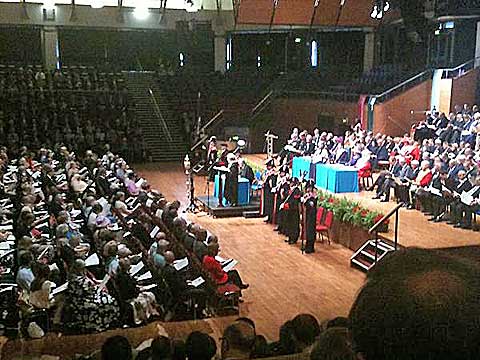
Preston Guild Hall
Preston Guild Hall, the Preston Guild ceremony 2012.

The council say the settlement with central government is another big reduction and something must give.  Without being an expert on council spending it’s hard to comment, but the buildings being discussed have been there at least 40 years and weathered worse storms than the current recession. Why is it that this time buildings are being knocked down.

It is logical to review all services and buildings and that is what they’re doing.  There are a lot of empty buildings in Preston that many citizens would like to be looked after, the old post office and Mount Street for example.  Hopefully the answer will not be a dull politically motivated announcement.  An assumption of better times to come should dictate the answers.

Preston Council’s D-Day (for Demolition)

Preston Bus Station under threat along with the Market Hall

On Monday 17th December 2012 Preston Council will have what may be their biggest day for a long time.  Transforming the face of Preston for 100 years.  Here is the list of demolitions taken from the Preston Council website, sounds easy if you look at it quickly:

‘It is recommended that Cabinet agrees:
2.1 The closure and demolition of the Market Hall, Car Park and Lancastria House;
2.2 The relocation of the Markets Operation: The design, location and scale of the replacement will be determined by the business case including sustainability, current traders’ requirements, funds, and heritage considerations. (A key objective is to preserve the character of the Market Canopies);
2.3 To instruct the Corporate Management Team to bring forward proposals for redevelopment of the Markets Quarter including refurbishment of the Market Canopies;
2.4 In principle, to demolish the Bus Station and Car Park and devise proposals to bring forward the site for development;
2.5 Delegate to the Corporate Management Team the authority to negotiate with the County Council a development scheme for the Bus Station and Car Park site.’

Knock down the Market Hall, yes please!

Refurbish the market canopies, yes please!

Knock down the Market Car Park, indifferent.

Knock down Lancastria House, the old Co-op, an attractive and worthy building. No!

Knock down the bus station, surely not!

The report, quite rightly, is is a long read. It sounds like the council is in trouble with its buildings, but I could list a few dozen repairs needed to our house but it will manage without. The council are trying to protect services.

Without reading it in full it is hoped the council isn’t making decisions that in the long term will be regretted, in particular the bus station and Lancastria House.  Services are here today and gone tomorrow but buildings create a visible long term character.

Two buildings were erected that always seemed badly positioned: these are the Market Hall and the Guild Hall.  That the bus station is on an island has never been popular, although it potentially has a modern airport feel inside.  These are interesting times.

Read the full Council report on the Preston Council website: downloads a pdf. There is a lot of information here.