Breaking the Bottle Necks with the Central Lancashire Transport Plan to 2025

More Parkway stations and bus routes planned for Preston while the bus station is to be halved in size and car park spaces reduced by around a 1000.
More Parkway stations and bus lanes planned for Preston while the bus station is to be halved in size and car park spaces reduced by around a 1000.

Lancashire County Council today published a transport paper that will be subject of public consultation in front of a government inspector in early 2013. The cost of the plan is estimated at £275million. It isn’t clear if a replacement Preston Bus Station is included.

In summary the plan includes improved road, rail and bus links with parkway stations, improved junctions and bus routes. The objective being to ensure that business investment in Lancashire isn’t constrained by transport issues. It certainly seems good progressive thinking.

Yet if transport is so significant, is Preston Council’s half size bus station and removal of 1000 parking spaces a good idea.  Most significantly it isn’t clear that the funding for any of this is available at this time.  You might think Preston Council would not vote to knock down the bus station without there being funding on the table for a new one.

A very ambitious plan would include a link from the A582 to the M55 via a river crossing west of the dock.

The plans include:

– a new road linking the M55 near Bartle with the A583/584 near Clifton to support new housing in North West Preston and the Enterprise Zone employment site at Warton.

– capacity upgrades to the A582 between Cuerden and the A59 at Penwortham.

– Penwortham Bypass direct link between the A582 Broad Oak roundabout and A59 west of Penwortham.

– improvements to roads to make it easier for people to catch the bus, walk or cycle. Focussing on nine ‘public transport priority corridors’ that follow all the main routes into Preston city centre, from Moss Side, Hutton, Warton, North West Preston, Broughton, Longridge, and Chorley, and Euxton/Buckshaw Village between Leyland and Chorley.

– introduction of more bus only lanes.

– improvements to rail stations at Preston, Leyland and Chorley, a new ‘parkway’ station to serve North West Preston would be pursued at Cottam.

– space to be given over to pedestrians and the opportunity to green public spaces, in areas such as Seven Stars, Hough Lane and Towngate, Tardy Gate, Bamber Bridge, Penwortham, Lane Ends, Broughton, Ribbleton Lane and New Hall Lane.

Central Lancashire Core Strategy – plans for development adopted jointly by Chorley, Preston and South Ribble district councils following a public examination earlier this year in front of a government-appointed Planning Inspector. Without this scale of highways and transport improvements.

The cost of the proposals is estimated to be in the region of £275 million, with various sources of public and private funding identified to support it. Key amongst these are developer contributions collected through planning obligations and the community infrastructure levy.

Thanks to the Lancashire Evening Post for bringing this report to our attention.
Reference Lancashire County Council report.

Preston Bus Station Demolition

A Preston Councillor was interviewed on Friday’s BBC North West Tonight. The gist of his statement was that the council could not afford to refurbish and keep open Preston Bus Station while it was under pressure on budgets for front line services.

This is the opposite to what he should have said. In times of hardship it is the duty of the council to think beyond the short term and protect the long term resources of Preston. If we destroy significant buildings to pay for a bit of short term difficulty there will be nothing of merit left. Good things always cost more than poor things.

To destroy infrastructure to pay for services is like knocking down your house to pay for heating. Soon there will be nothing to heat. We are often told that infrastructure comes from a different budget to front line services, however, it seems when it suits them it doesn’t.

Another factor is what interest rates can local authorities borrow at, and what grants are available to maintain such buildings. Blackpool Council purchased the Tower and Winter Gardens using the argument that a local authority can borrow much more cheaply than a company. The Tower is operated by Merlin Entertainments who pay the council. Perhaps no-one is interested in operating a bus station and car park but what options have the council considered?

It seems that this is a very serious decision by the council and the public should be advised how the decision was made and what the options are. In Winckley Square the council proposed swinging letters, searchlights and a totem pole, this doesn’t inspire confidence that this decision is wise.

Preston Bus Station to be destroyed by lack of vision

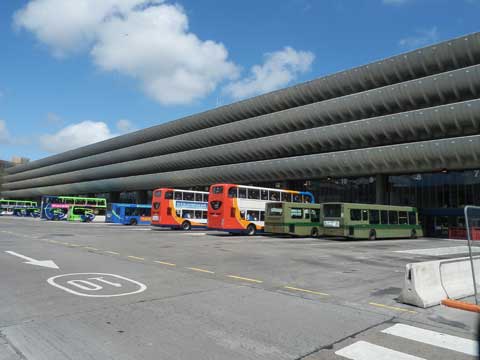
Preston Bus Station an iconic building to be demolished.
Demolition of Preston Bus Station will leave an anonymous space where once was a late 20th Century icon.

Preston Bus Station destroyed by vandals might be a bit hard.  Yet Preston Council have neglected the building and then announced that it will cost too much to refurbish. Even though it is one of Preston’s main features.

Quoting huge costs the council seeks to justify its case. Yet in nearly every case it looks like the council has opted for Gold Plated Solutions Ltd to do the work and since when did a council pay £2m interest on a £23m loan.

The council has let it deteriorate so it doesn’t look so good at close inspection and many will be taken in by that.  Yet from a distance it becomes more iconic with every passing year. Along with the Harris Museum and St Walburge’s it is surely a symbol of Preston and how it was prospering beyond the cotton era.

It is situated a mile from the railway station so if they said it was being moved then maybe that would increase the case. Or if they said something equally magnificent was going in its place. But no, this end of the centre is going to become a small bus station and a car park.  Welcome to Preston or is it Bury or Blackburn.  Maybe like Blackpool it will have no bus station and no-one knows where the buses are and they jam the streets.

There might be an option for knocking down half of it to leave a shortened building although no doubt that would be said to cost even more.

There is something solid and magnificent that adds to the claim to City status about the bus station. The other towns will be laughing and saying no Tithebarn, no iconic bus station, Preston is falling, come to us.

Owner of the former BTR Leyland sells off rail interests

When I left school I went for an interview at BTR (British Tyre and Rubber) in Leyland but luckily they didn’t want me. That factory closed with the downturn in manufacturing and end of Leyland Motors as a stand-alone company. BTR then became part of Invensys, makers of control systems.   It was announced yesterday that Siemens of Germany will buy out Invensys Rail for £1.74bn.  Invensys will then become a software, systems and control equipment company for oil, gas plants and domestic appliances, and be able to pay off its large pension debt.  Invensys shares have risen, shareholders will take a payment from the deal as well.

Regretfully another British industrial activity is heading for overseas control.  Invensys have interests in Chinese railways and are working on Crossrail in the UK.  It seems that as British rail investment has increased we have become mainly importers of trains and now the signalling technology is going to be controlled overseas.  Our prolonged debates about transport and infrastructure in general is no help to creating the stable strategy that investment in manufacturing requires.  Yet this seems to be financially a good deal for the company.

Police Commissioners – Labour candidate wins Lancashire

The Labour candidate, Clive Grunshaw, won the Police Commissioners £85,000 a year role in Lancashire on a 15% turn out and winning 39% of the first votes.  This gives him about 6% support overall, and a lot of indifference.

Not a job most would look forward to, so we wish him well.  To interject into the system will take some teeth, although the powers given to the commissioner give him some bite and a person of substance will make themselves felt.  The local BBC news gave the Merseyside commissioner the most publicity and she didn’t give the impression she’d take any prisoners if she was crossed.

We should give this a go and see how it works. There is a feeling that the police should be seen more everywhere, whether that can be achieved without more police and by cutting paperwork, like the government wants, is to be seen.

Politicising the police is a worry and we’ve already seen the new commissioner making statements that could be said to be critical of the government. We’ve also seen this week, in Rotherham, that certain political views can be read as unacceptable so there could be a fear related to this.

Overall we’ll hope the new system works for everyone and that it will get more support and interest as it goes on.  Although it is quite possible that continued dis-interest is more likely.

Police Commissioners – voting

It seems a bad idea to let each region have a police force led by someone with a political allegiance.  However an election is being held on the 15th November for Police Commissioners.

From a simple and non-party perspective it seems that law and order is likely to be best supported by a Conservative or a UKIP candidate.  Although at the moment the Conservatives seem to be cutting back the police and saying they can operate more efficiently. Perhaps there is a case for that, but it might be a better idea to make them operate more efficiently and spend some of the saving on more police.  The riots in London and around the country a couple of years ago showed how thin and impotent the blue line is when challenged by a violent mob, and the TV programme ‘999 What’s Your Emergency’ shows that more and stronger policing is required.

I read a statement from the Conservative candidate, Tim Ashton, that he wants 20mph speed limits to be widespread.  I’d support this in front of schools and perhaps at school finishing times but it seems ridiculous driving at a snails pace in second gear on an empty road for miles like in Garstang and Knott End. For me this counts him out and his statement seems to parrot the party line which is another negative in showing lack of imagination.

For these reasons, although I support membership of the EU and dislike UKIP, on this issue they have my vote.

Olympic Torch Relay in Preston

The Olympic Torch passed through Preston on the 23rd June.  Some 10,000 turned out to watch it. It is fascinating how many watch this and why. We went to Garstang, the day before it went through Preston, and the weather was terrible.  Yet the streets of Garstang were packed.

There was the waiting in the rain, then the short cavalcade followed by a runner carrying a torch. Then it was gone. This has struck a chord with the public and seems to signal big support and interest in the games.  Let’s hope so and that it all goes well. This is the biggest sporting event in the world.

What next for Lord Coe? He’s been a great front man and must surely get more honours. It’s what the honours system is about, recognition for good work.

Parliament debates BAE redundancies

On November 24th a debate was held in parliament on the redundancies at BAE SYSTEMS primarily at the Warton and Samlesbury plants in Lancashire and the closure of the Brough site in Yorkshire. The prime mover was David Davis, the MP for the Yorkshire seat containing the Brough site. Also Alan Johnson, the MP for Hull West.  The debate was poorly attended with only those from threatened sites turning up. These included North West MP’s: Ben Wallace, Mark Menzies, Jack Straw, Mark Hendrick, Lorraine Fullbrook Graham Jones. With  Nigel Evans sitting in as Speaker. The government was represented by Peter Luff, Parliamentary Under Secretary of State for Defence Equipment.

The main speaker was David Davis who raised points about the betrayal of a long history successful work at the Brough plant. That the Hawk still has prospects for sales and that much of it is being offered to overseas companies in ‘offset’ deals to gain more sales. Also the point was raised that BAE had made the error of selling off its commercial aircraft interests which had often taken up the slack when defence orders are slow. A plea to slow the rate of redundancies at Brough was raised.

There was also talk about the terms in the ‘yellow book’ which represents the trading agreements between government and industry. This relates to guaranteeing jobs to maintain capability and covers who pays for redundancy costs. It seems the government pays in this case. Some MP’s think BAE is exploiting this.

Others mentioned large overspends that need to be reduced and ensuring the ability to satisfy future projects.

Each MP spoke. It seemed reading the debate that very little was said that hasn’t been said a dozen times. It is perhaps unusual for redundancies at one company to secure so much time for discussion and it left me wondering what was achieved. At the end there was a resolution which might mean more in politics than it does when reading it. This says;

That this House urges BAE Systems to act to preserve the UK’s defence production skills base and, as a recipient of enormous resources over many years from the UK taxpayer, to deploy those resources in such a way as to protect the nation’s manufacturing capability.

Or it seemed;  Carry on as planned,  if what you make costs more and what you can offer is limited by inflexibility then you reduce the chance to sell it, and so could lose more jobs.

It could be argued that to preserve jobs the government should place contracts that pull work forward or create new research. In the current climate this seems unlikely.

An overview of defence as a whole could read as follows. Over the years the UK aircraft industry has consolidated to a few plants and BAE has changed from an aircraft company to one that delivers systems with a large part in the US. Also the number of projects has declined and it appears that the UK is likely to become an aircraft ‘part’ manufacturer. With UAV’s potentially creating work but it isn’t clear how that will evolve. The alternatives come with large bill. Perhaps a measure of the UK’s decline over the years coupled with increased complexity and the range of military options from tanks to submarines, UCAV’s and very expensive electronics, counter-measures, surveillance and cyber-warfare. Where to focus? Which elements to play a major part in?  Off the shelf, licence build, direct purchase? A lot to consider.  Let’s hope we can maintain a viable aircraft industry producing whole aircraft rather than a bit player. Today we might not be optimistic. Only the French put national glory and maintenance of capability on an equal pedestal to financials e.g. Renault, Airbus, TGV, Nuclear Power, Ships.

The aircraft industry has been recognised as one that generates large export earnings through products and services over long periods of time.  Aircraft also contain a wide range of sophisticated equipment that provides high technology business and employment all over the country and these items are also exported. The business fosters close relationships and partnerships with other countries of all sizes that often leads onto other business, particularly infrastructure, as well as demonstrating a capability to participate in future high technology international ventures. Investment in aircraft projects provides the likes of BAE, Rolls Royce, Martin Baker, Marconi with the foundation for their products. There is a lot to lose without care.

Read the full debate on the website ‘they work for you’.

http://www.theyworkforyou.com/debates/?id=2011-11-24a.472.1&s=speaker%3A11668#g475.0


20mph Speed Limit in Lancashire

Lancashire County Council popped a leaflet through our door today announcing that our road will have a 20mph speed limit to improve safety and improve the local environment. The leaflet says that the objective is to make driving at 20mph second nature.

One solution to this irritation is to stop voting in local elections because no-one asked for this and yet here it is. To let us know we are in the 21st Century and consistency is a thing long forgotten the motorway speed limit is expected  to go up to 80mph and red tape and regulation is to be reduced. Obviously a significant number of these incidents aren’t on roads that will be part of this exercise.

The leaflet contains no data or targets for improvement. Yet searching the internet it seems that in the last 5 years the number of serious injuries and deaths on Lancashire roads has reduced from about 1100 to around 800 although deaths seem to fluctuate around 60 people.

Who’d deny that saving one life isn’t worthwhile and yet this seems like another handcuff for decent people being spread broadbrush.  Let’s face it there are jobs at stake here, jobs creating rules and how proud you’d feel to have brought in such a rule. How proud you’d be that having landed a job in safety you improved it even though the environmental department got a pasting with increased emissions that created a demand for further restrictions and the NHS got more asthma cases in hospital. Bravo!

Goodbye Tithebarn Project

This week John Lewis pulled out of being an anchor store in the proposed Preston major development, Tithebarn. The state of the economy and job losses at BAE Systems were quoted as contributing to the decision.  Although one national paper said John Lewis might still be interested in an out of town store and haven’t given up the area completely as a Waitrose is planned in South Ribble.

After over 10 years of debate and delay it is surprising anyone is still in the project. Blackburn must think they won in the end by delaying it with their legal challenge.

What now? A smaller project is mooted with no bus station and containing an M&S. There must be a clue here and with the Winckley Square on-going discussion that the way to get things done needs to be changed. It might be thought that John Lewis would have come into Preston years ago if the first stage had been to build their shop, and perhaps M&S, along with parking. Shrinking the bus station to half its size would have left part of its iconic shape and been big enough while providing car parking space as well.

Grandiose plans have created an all or nothing state similar to Blackpool when the casino dream died.  Yet after being badly holed Blackpool has obtained a lot of money to rejuvenate its centre, the tram system and its two best known buildings and is now starting on a Central Business District development. So perhaps Preston can dust off its plans and start a more realistic scheme phased sensibly so not to disrupt the centre for years and not to frighten the neighbours.

Preston’s Old Buildings Departing

This week Preston Council granted planning permission for houses to be built on the land now occupied by the Park School on Moor Park. This school educated generations of Preston females who passed their 11+ exam, including my mother and her sister some 70 years ago. It is granted that the school doesn’t look very interesting except for the tower over the entrance which has some elaborate stonework. To appease conservationists this will be put into storage, including the pieces containing the Preston crest and the words ‘Park School’.

Whether demolishing the building is good or bad is open to question. The attractiveness and potential uses of a building change with time. Many an old hovel was knocked down and now they are classed as characterful and in demand to live in or as tourist attractions.  At this time the elaborate stonework contrasting with the red brickwork is the main feature of Edwardian buildings and it could be said there are still quite a lot of them around. Also there is a need to build on brownfield sites rather than greenfield and as travelling becomes more expensive building near town centres is likely to become more popular.  On balance the decision seems acceptable.

The other old building in the news is the former Park Hotel, built 1883, a major feature of Preston, having a commanding position over the Grade II listed Miller Park. This building is deemed surplus to Lancashire County Council’s use as offices and staff are being moved into the main Pitt Street offices. The building will then be put on sale. If justice was to be done it would be kept as Council Offices as that is one of the best ways to preserve it.  It might be thought that a preservation grant would be available to councils for this. Let us hope that a good use is found although the recession and general cut backs make this unlikely in the short term.

The preservation of buildings is a controversial subject. There are as many opinions as people and we can’t keep every building. Those no longer fit for a purpose have a difficult time.  The main bus station and Mount Street Hospital being two buildings at risk. Proposals to modernise buildings and places are often sacrilegious, like the hanging letters on Winckley Square.  Careful planning and cash are needed. Of the above buildings it seems the Park School isn’t worth keeping but the former Park Hotel should certainly have its exterior shape preserved at least.

High Speed Rail consultation period ends

The High Speed Rail consultation period concluded at the end of July and decision making will take until the end of the year. At present the line is planned to extend as far as Manchester in the north-west but it is said that High Speed trains could continue to Glasgow along conventional lines at slower speeds. Lancashire could get some benefit from the service either via Manchester or by joining the line further south. There could also be benefit from the freed capacity on the conventional track. If fuel costs continue to increase rail travel could increase dramatically as it already has started to do and the current plan is much too slow.

The previous government planned that £2bn a year would be spent on rail. Crossrail and Thameslink in London would spend that up to about 2017 when High Speed Rail work would start. Yet it seems very unfair that all the investment is going into London while the rest of the country gets London’s old rolling stock as they get new trains. There are 55million people living outside London and the gap in wealth gets larger while more and more money is poured into London – the Olympics being another example. Surely it is time for some equality.  It is said that London is more dependent on rail transport yet it has the only high speed rail line in the country and that goes outside the city to Europe. So London is sucking in people from outside to use its monopoly position. Why should people from the Midlands and the North need to travel to London to go to Europe on the train.

London is currently like a pressure cooker, hemmed in by small hills north and south and nothing of significance crossing those barriers. High Speed Rail will release some of the pressure and it would be expected to shrink the country so that areas well beyond those hills feel the benefits of the London investment effect. On top of that it could release capacity at Heathrow for lucrative international flights rather than domestic ones.

The need for a high speed line is here now, the West Coast Main Line is very busy and increasing train length is only a stop gap. Adding more track will cost as much if not more than a High Speed line.  Building should commence on the full length of line to Manchester and Leeds immediately with a target opening date in 5 years. British engineering companies should be given research funding to develop train technology. Work should also start on improving the track to ensure High Speed compatibility all the way to Scotland. The recession provides a benefit by reducing costs and the project will create jobs.

Tithebarn another step forward

The appeal by Blackburn against the Tithebarn project has been rejected.  Blackburn are now considering whether to make a further appeal although most think it’s throwing good money after bad.

Whether the Blackburn appeal has already done its job might be another factor. The delays to the project have put it into a time when retail on the high street is going through a bad patch.  Investors now need convincing that there is the prospect of a return. In the last week alone well known retailers like Habitat, Jane Norman and TJ Hughes have called in administrators. The battle between the high street and the internet is one reason, not to mention out of town shopping, and it might be thought that over the longer term the internet can only get bigger.

If it is true that John Lewis are looking to open a store they are one of the few retailers that isn’t doing so badly. Although their business tends to be with people who have a decent level of disposable income, whether Preston can still present many of this type of customer might be questioned.

The government is also looking to steer the economy away from the consumer led boom and high borrowing.  Also the cost of Chinese made goods is increasing. Whether this means retail will no longer be a growth area and growth will come from other businesses might tip the balance of the project away from retail and towards business premises. It has seemed possible that Tithebarn is expanding Preston’s retail area more than might be sustainable if you add in out-of-town supermarkets and retail areas.  A watch needs to be kept on potentially conflicting interests; developers, builders, retailers, businesses and the council, to ensure that a white elephant doesn’t appear in the heart of Preston or that it compromises the rest of the centre which is looking quite smart now.

The Street That Cut Everything

Out of thousands of streets in the UK the BBC selected a street in Preston for ‘The Street That Cut Everything’ broadcast last week.  Meant to highlight the difficulty of providing public services with a limited budget it seemed to score more on Big Brother personal trials and conflict.

In this world the council empty your bin onto the street and then turn off the streetlights, some might say what’s new.  Then at night when it’s completely dark mindless graffiti, fly tipping and a mass dog fouling exercise occur. What’s new? This being TV, solutions must be found immediately, wrong ones are penalised and conflict dramatised.

Novel solutions like storing waste in the lounge and filling your garage with fly tipped junk are used. A spotlight is hired for street lighting. But these are just an inconvenience.

The most contentious part is social care. One family needs extra financial help because of low income.  An old lady had previously been taken by council supplied bus to the shops and residential centre.  As the final twist a lady wanted help from this street for her father who lived somewhere else.

We all had opinions but you couldn’t help admire Mr Can do, the caravan salesman who arranged the lights and generally kept upbeat.  A lot of people put in a lot of elbow grease. Some were good at talking but weren’t seen doing a lot. Some seemed to want more than they appeared to be putting  back, although in the limited time you couldn’t get a full picture. Overall it seemed as good a range of sensible and decent people as you’d find.

The success appeared to be with the old lady who  was an invisible street member until the show, whether this lasts beyond the show time will tell. The most interesting was the resident who expressed entitlement, an idea that often causes strong feelings, and you might wonder if this scene was set up to stir the pot for the show. The residents voted to provide all the needs even though they had no money left but not without it causing bad feeling from those who felt they didn’t have much but managed.

One case thrown in seemed to test reality.  Whether to support a residents disabled father who lived elsewhere.  Wouldn’t the street where the father lived pay for his help in reality? Yet it was agreed, with some being in no doubt it was right, and some seeming to have given up.

In the end Mr Can Do said the programme had created divisions that may never heal and the lady who wanted benefits said she’d move. That’s what you get when your personal life is laid open to those nearby to judge. It made decision making look difficult and recognition for council services. Yet, if you’re thrown in the deep end with no training it will look difficult and as councils have more than council tax for income it wasn’t clear that the refunded tax was all they were entitled to, so their budget was probably low.

Overall it scored on entertainment and gave some perspective of decision making, but didn’t give a broad or deep insight or have any after programme discussion into what was learnt. Some people expressed more sympathy with the council, and why not. In general councils do a good job in a very civilised way, but it might be you think it could be done even better or cheaper.

University of Central Lancashire £9,000 fee ripples

Following the announcement last month that UCLan will charge £9,000 a year for students enrolling in 2012, Blackburn FEC is to break its association with UCLan as it has proposed to charge £7,000.

UCLan is well down the performance tables of universities and it was a surprise when it announced it would charge the maximum fee.  The government didn’t intend that universities such as UCLan would charge so much. Yet universities can ask for the fees they need to develop their institution subject to approval of plans to accommodate certain students.

Perhaps it’s similar to the BBC who seriously expected license payers to accept a very large increase to fund their dreams of expansion. The government limited the BBC and now they are being restricted even further by the new government.

Did the government misjudge how much universities need or are the universities making the most of what is possible.  Ultimately the taxpayer pays until the loan is paid off. Yet as it’s likely to be 2015 before the smallest repayments are made, there is no government saving for a long time. On the other side it appears some universities will be raking it in from 2012.

Read more about Blackburn FEC:

http://www.timeshighereducation.co.uk/story.asp?sectioncode=26&storycode=416063&c=1

Preston Council May 2011 Labour Gain Control

On May 5th the local elections were contested in 19 out of a total of 57 council seats in Preston.  Of these 4 changed hands giving Labour a narrow gain with an overall majority of 1 councillor.

The full council now comprises: Labour 29  (+4), Conservative 21 (-1), Liberal Democrats 6 (-1), Others  1 (-2).

The seats were last contested in 2003 so it isn’t easy to compare like for like, but Labour achieved an increase in vote of 6000 votes or 40% compared with the seats contested in 2007 while the Liberal Democrats lost 2000 votes or 48% compared with 2007. The Conservatives breaking even.

It could be concluded that results followed a northern trend where the Liberal Democrats lost votes to Labour, whereas in the south the LD’s lost votes to the Conservatives.  While the Conservatives maintained a national trend of not losing voters. The LibDems are said by some to be suffering for being a party in government rather than a protest group for disaffected voters from other parties. This could be an honest position for true LibDems, if unpreferable.

Residential Speed limits to be 20mph – ridiculous!

Lancashire County Council announced that all residential roads will have a speed limit of 20mph by 2013 to create a new attitude towards speeding and reduce road deaths.

There is some merit in the proposal but how many deaths will it save and will it change peoples attitude.  It’s easy to come up with objections to any change, and lately we’ve seen plenty, but 20 mph is very slow.  What is a ‘residential road’?  Is Garstang Road or Watling Street Road residential or is it just side roads. How many street signs will it need. A 100yd cul-de-sac with a 20mph speed sign on it?  Who is going to enforce it, will it be 3 points on your license for travelling at 23 mph in mid-morning? Also it can be confusing to pedestrians who think cars are at a distance not to cross then they take longer to arrive and you are tempted to cross.  It certainly isn’t environmentally friendly or cheap as a reduction in miles per gallon approaching 20% might be expected.

Outside schools and within a certain distance it seems a reasonable idea although there is a school near us with a full set of humps and full time 20mph restriction and it’s so irritating when there is no-one about to manoeuvre round these humps and drive so slowly.  In Leyland they have sharp edged humps which should be illegal, keep away if you like your car.

Update: It seems that it is restricted to side roads, however that is defined.

The Strange Story of the Secret Park and Ride

Down in Bluebell Way, east of Preston in Lancashire lies a secret Park and Ride.  No-one knew why it was there or what it was for.  It seems someone had a good idea and then there it was. If only other plans around Preston could be executed so well.

To build a park and ride with no-one wanting to park there and bus services to no-where in particular isn’t the best example of planning. Now Lancashire County Council are looking to sell it and are looking for ideas of where to build another one.

Is Preston congested?  Probably at rush hour it is, but the rest of the time there is no problem at all.   If Tithebarn is built will this create more traffic?  Yes, but most people travelling to the type of stores being proposed aren’t going to be keen to take a long bus ride, if they want to take one at all. 

Park and Ride doesn’t appeal unless its very efficient, secure, not too crowded and if the city is unfamiliar. That means the Preston Park and Ride to serve the north, east and more distant south, if it’s necessary, should be on Moor Park as it has easy motorway access and isn’t too far out of the centre. It could also serve Deepdale Retail Centre and be used for the football.  Using Moor Park might be controversial but it depends on how big the car park is and whether the council can sweeten this by smartening up the park and providing facilities that might appeal to people who are using the car park.

Manchester to Blackpool rail electrification by 2016

Philip Hammond, the Secretary of State for Transport, stated in Parliament on the 25th November 2010:

‘The Chancellor also announced on 20 October the electrification of the lines between Liverpool, Manchester, Preston and Blackpool, representing an investment of up to £300 million. I expect work in the north-west to begin next year and to be completed at about the same time as work on the Thames valley commuter lines, in 2016. Some sections will be completed well ahead of this, notably Manchester to Newton-le-Willows in late-2013, allowing new electric trains to operate from Manchester to Scotland. As with Thameslink, we will require Network Rail to keep a tight rein on costs. The redeployment of electric rolling stock to these routes will, in turn, free up hundreds of diesel units, which will be available to train operators to lease as they become available in the period after 2015.’

In a further reply he stated:

‘…..Electrification will allow the electric carriages released by the delivery of the new Thameslink carriages to be deployed. There is no point completing that electrification (Man. to Blackpool), except for the section from Manchester to Newton-le-Willows, until those electric carriages are available. The timetabling is perfectly logical and the early completion of Manchester to Newton-le-Willows will allow brand-new electric trains to be operated on the Manchester to Scotland routes.’

Some good news then.  In 2011 start electrifying the line from Manchester to the West Coast Main Line at Newton le Willows which will enable the diesel powered trains to Edinburgh that run through Preston to be new electric trains by late 2013.  While the remainder of the electrification from Manchester via Bolton and Preston to Blackpool will be complete by 2016, as well as the Liverpool to West Coast Main Line track. The bad news being that the line through Preston gets second hand stock from London, but better that, than nothing and the lines around London are much more congested so bigger faster trains are needed.

Manchester to Blackpool Rail Electrification

It was a surprise to discover the good news announced in the governments spending review on 21st October 2010 seemed to have no coverage.  Here is what the chancellor said:

‘In the North West, we will invest in rail electrification between Manchester, Liverpool, Preston and Blackpool and we will provide funding for a new suspension bridge over the Mersey at Runcorn.’

Must admit that when it was first announced it appeared to be a stunt by the last government to get votes and there is no saying it’s still not a vote buyer.  No dates have been announced but little detail was announced on many items. Presumably the transferring of rolling stock from London is still on the cards and probably offsets some of the cost.   With the doubt over routing of the High Speed Train this is presumably a shorter term improvement and will enable a lot of service improvements by allowing electrified trains to travel between Manchester and Blackpool as well as to Scotland from Manchester and Blackpool from the south.